Storm clouds over the Arctic

SAIL Outcomes

2026

Ocean-E2E: Hybrid Physics-Based and Data-Driven Global Forecasting of Marine Heatwaves with End-to-End Neural Assimilation
Marine Heatwaves Neural Assimilation KDD 2026

Ocean-E2E: Hybrid Physics-Based and Data-Driven Global Forecasting of Marine Heatwaves with End-to-End Neural Assimilation

Ruiqi Shu, Ruijian Gou, Yanfei Xiang, Xiaomeng Huang (2026). Accepted by ACM SIGKDD Conference on Knowledge Discovery and Data Mining, AI for Sciences Track.

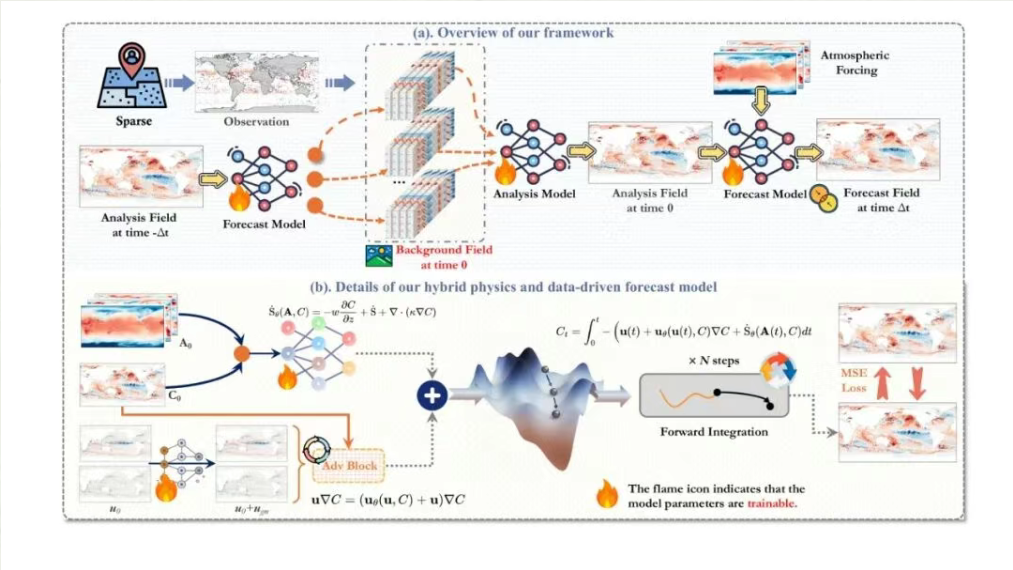
Ocean-E2E combines physics-guided ocean dynamics, data-driven forecasting and end-to-end neural assimilation for 40-day global marine heatwave prediction. By allowing observation information to directly shape the initial analysis field and subsequent forecast trajectory, the framework improves long-range marine-heatwave forecasting and regional high-resolution simulation.

Read Paper

HybridOM: Hybrid Physics-Based and Data-Driven Global Ocean Modeling with Efficient Spatial Downscaling
Hybrid Ocean Modeling Physics + AI ICML 2026

HybridOM: Hybrid Physics-Based and Data-Driven Global Ocean Modeling with Efficient Spatial Downscaling

Ruiqi Shu, Xiaohui Zhong, Qiusheng Huang, Ruijian Gou, Tianrun Gao, Hao Li, Xiaomeng Huang (2026). Accepted by International Conference on Machine Learning.

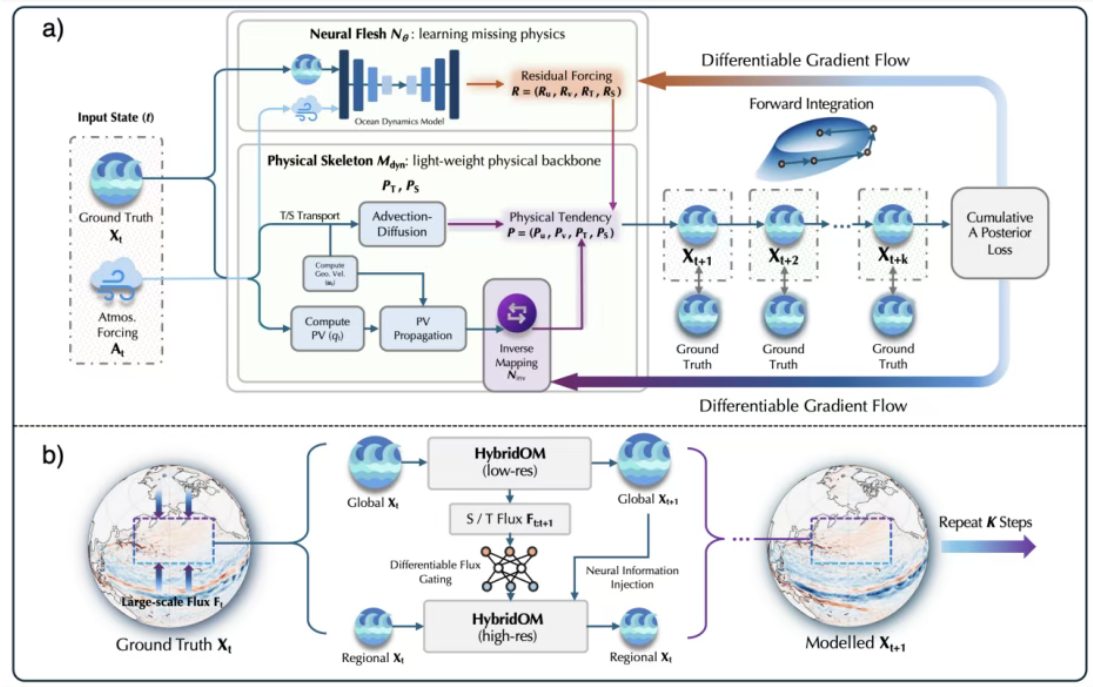
HybridOM integrates a differentiable physics-based ocean core with neural-network correction to improve ocean simulation, operational forecasting and spatial downscaling. The framework treats physical models and AI components as a coupled trainable system rather than a post-processing pipeline, supporting more stable and physically consistent global ocean prediction.

Read Paper
Polar processes set Arctic marine heatwaves apart
Arctic Marine Heatwaves Polar Processes Perspective

Polar processes set Arctic marine heatwaves apart

Marylou Athanase, Ruijian Gou, Eike E. Köhn, Benjamin Richaud, Amélie Simon (2026). Communications Earth & Environment, 7, 485.

This invited Perspective synthesizes how polar-specific processes distinguish Arctic marine heatwaves from lower-latitude events. It reviews the role of sea ice, stratification, air-sea coupling and Arctic ecosystem sensitivity, identifies key methodological challenges in event detection and baseline selection, and provides a framework for future Arctic marine heatwave research.

Read Paper
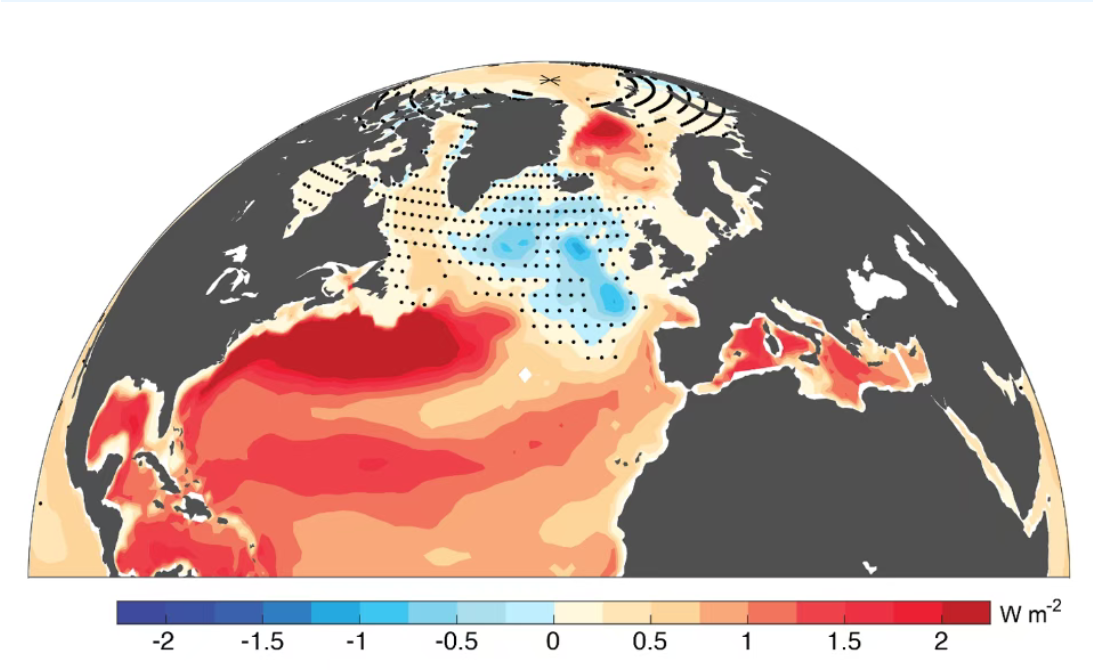
Multidecadal Atlantic warming hole heat content variations are caused by ocean heat transport, not by surface fluxes
North Atlantic Ocean Heat Transport GRL

Multidecadal Atlantic “warming hole” heat content variations are caused by ocean heat transport, not by surface fluxes

Stefan Rahmstorf, Ruijian Gou, Lijing Cheng et al. (2026). Geophysical Research Letters.

This study examines the mechanisms controlling heat-content variability in the subpolar North Atlantic warming hole. The results indicate that multidecadal ocean heat-content variations in this region are mainly governed by ocean heat transport rather than local surface heat fluxes, highlighting the dynamical control of ocean circulation on regional climate anomalies.

Read Paper
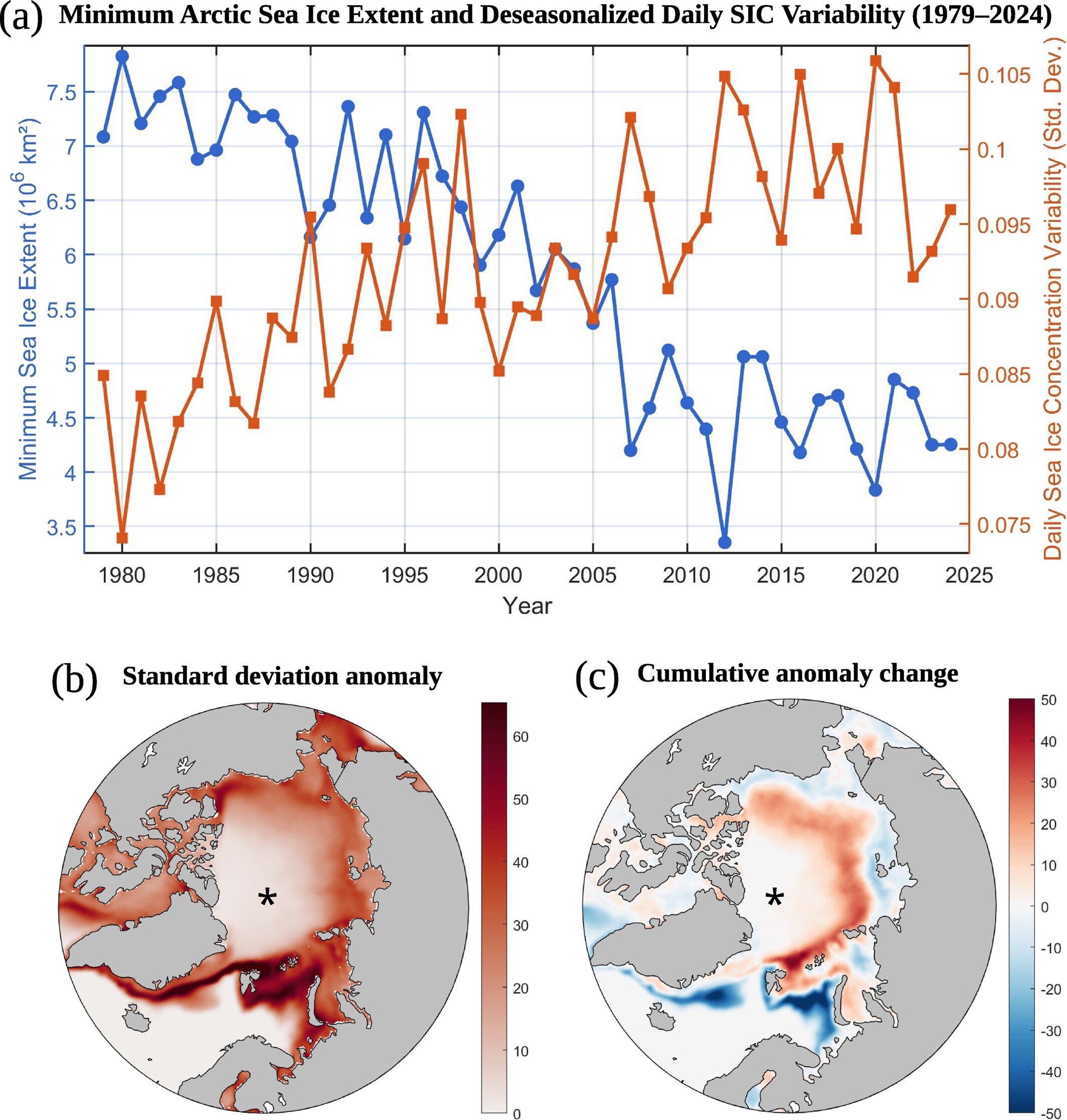
Increased Arctic Sea-Ice Variability Is Associated With Amplified Air-Sea Heat Fluxes
Arctic Sea Ice Air-Sea Heat Flux GRL

Increased Arctic Sea-Ice Variability Is Associated With Amplified Air-Sea Heat Fluxes

Yanni Wang, Gerrit Lohmann, Ruijian Gou, Huaming Yu, Xiao Hua Wang, Jun Meng, Jingfang Fan, Lixin Wu (2026). Geophysical Research Letters.

Based on multi-source observational and reanalysis datasets from 1979 to 2024, this work identifies a prominent increase in daily sea-ice variability in the Arctic marginal ice zone after 2007, accompanied by enhanced seasonal air-sea heat exchange. The study highlights a positive feedback between short-term ice fluctuations and anomalous heat fluxes, and shows that missing short-term sea-ice variability can lead to systematic bias in conventional climate simulations.

Read Paper
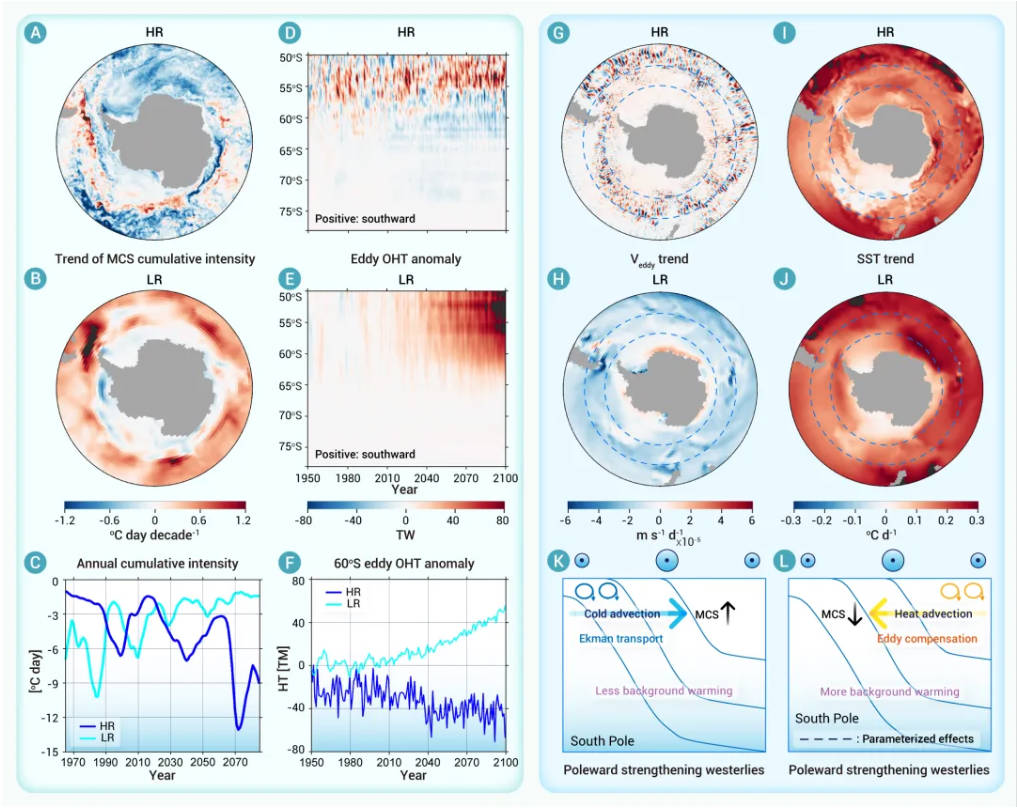
Eddy-resolving simulations reveal amplified marine cold spells in the Southern Ocean under greenhouse warming
Southern Ocean Marine Cold Spells Eddy-resolving Simulation

Eddy-resolving simulations reveal amplified marine cold spells in the Southern Ocean under greenhouse warming

Ruijian Gou, Gerrit Lohmann, Wenju Cai, Gregor Knorr, Lixin Wu (2026). The Innovation, 7(6), 101399.

This study uses eddy-resolving climate simulations to examine future Southern Ocean marine cold spells under greenhouse warming. It shows that mesoscale eddy dynamics can amplify cold-spell intensity and frequency despite mean ocean warming, emphasizing the need to resolve small-scale ocean processes when projecting future marine extremes.

Read Paper
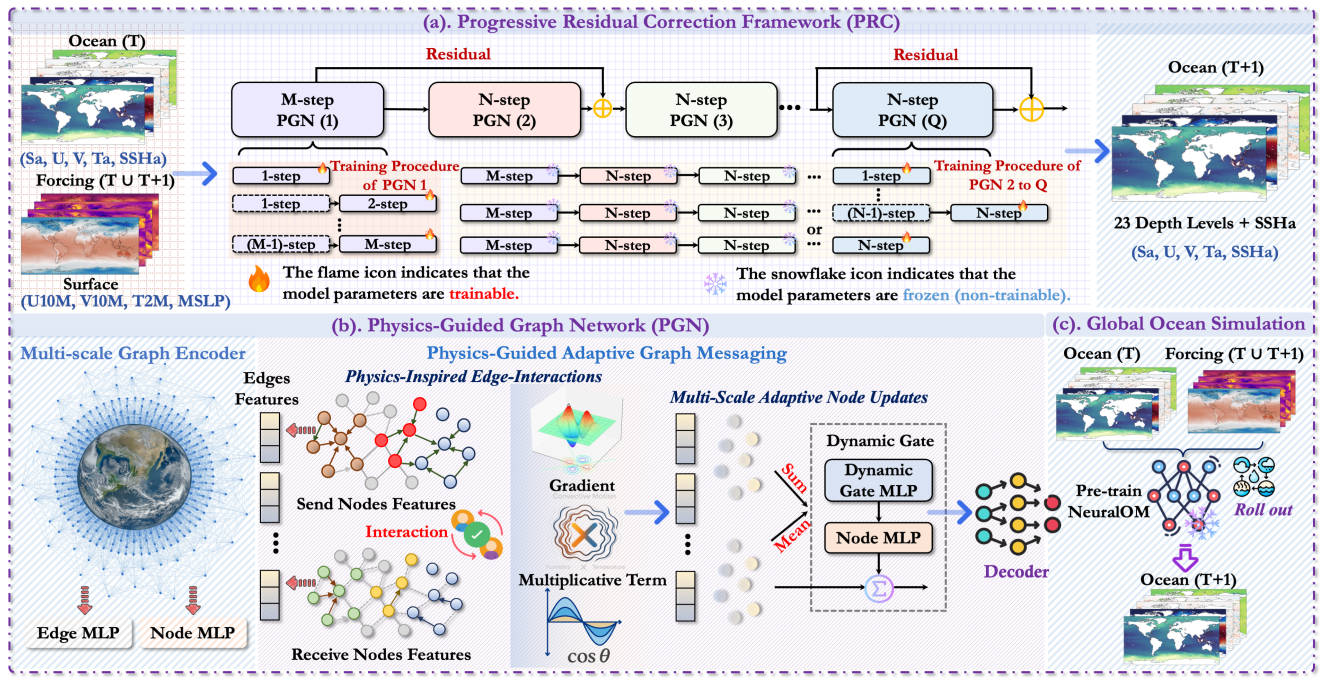
NeuralOM: Neural Ocean Model for Subseasonal-to-Seasonal Simulation
Neural Ocean Model Subseasonal-to-Seasonal AAAI

NeuralOM: Neural Ocean Model for Subseasonal-to-Seasonal Simulation

Yuan Gao, Ruiqi Shu, Hao Wu, Ruijian Gou et al. (2026). Accepted by AAAI-26; arXiv:2505.21020.

NeuralOM combines progressive residual correction to restrain cumulative error with a physics-informed graph network to explicitly resolve multi-scale hydrodynamic couplings. In global subseasonal ocean simulation, it reduces 60-day RMSE against benchmark models and improves the reproduction of extreme events, forming an efficient physics-compliant data-driven ocean simulation framework.

Read Paper

2025

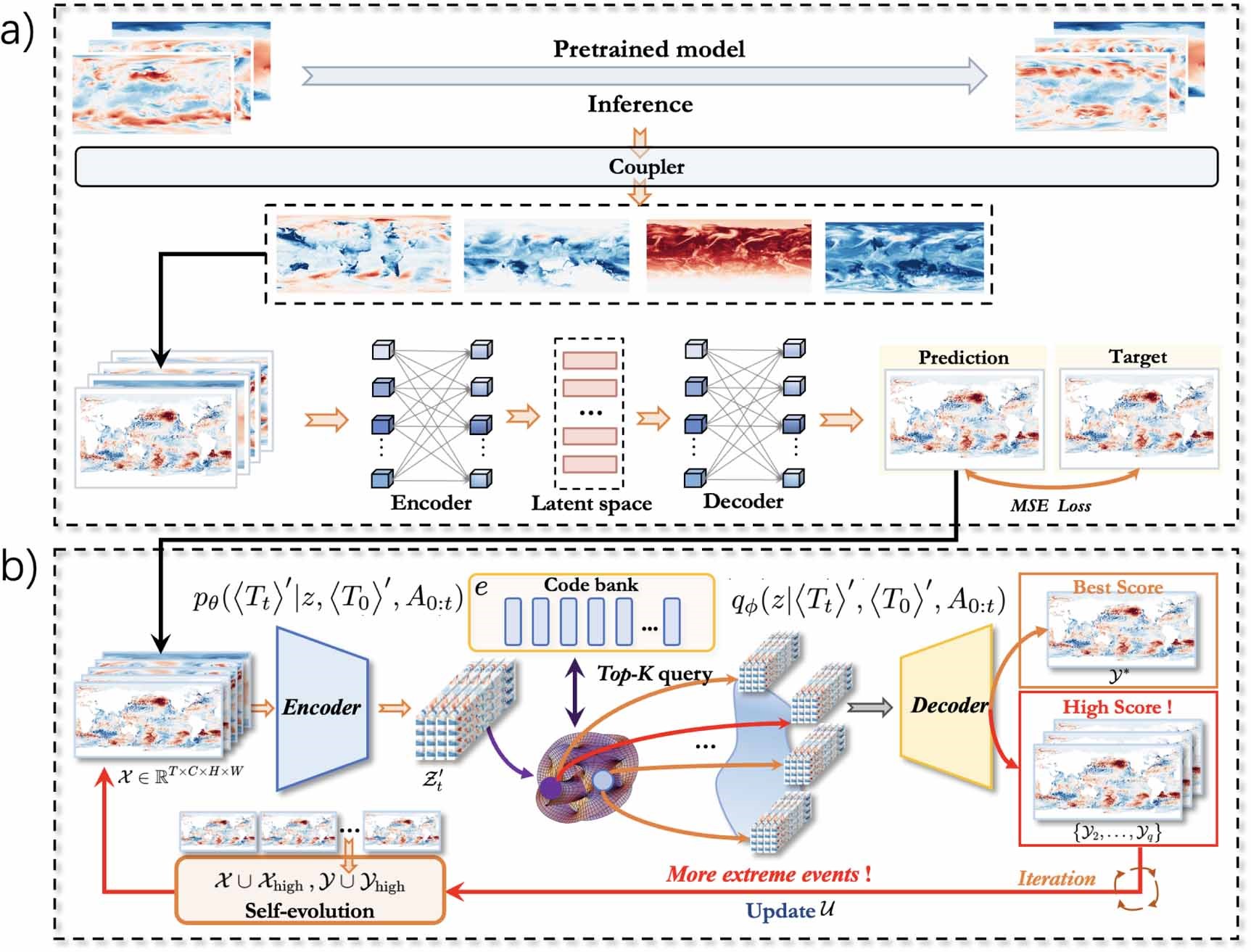
Advanced forecasts of global extreme marine heatwaves through a physics-guided data-driven approach
Marine Heatwaves AI Forecasting Physics-guided Learning

Advanced forecasts of global extreme marine heatwaves through a physics-guided data-driven approach

Ruiqi Shu, Hao Wu, Yuan Gao, Fanghua Xu, Ruijian Gou, Wei Xiong, Xiaomeng Huang (2025). Environmental Research Letters, 20, 044030.

This study develops a physics-informed deep learning framework for 10-day forecasts of global extreme marine heatwaves. It incorporates atmospheric forcing through a coupler module and uses probabilistic data augmentation to improve predictions for rare extreme events. Explainable AI results indicate that surface wind is a key driver of marine heatwave evolution through air-sea heat exchange.

Read Paper
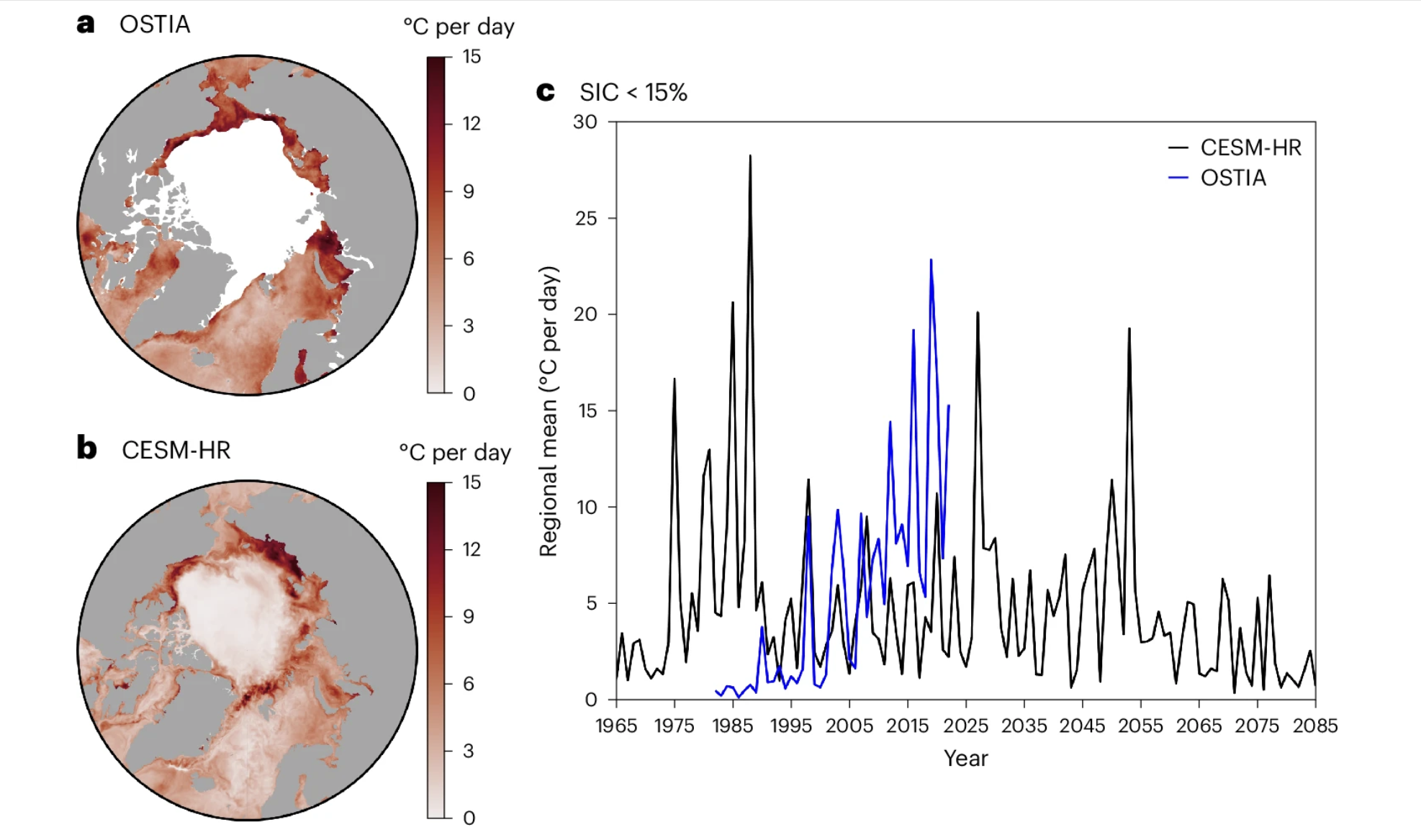
The changing nature of future Arctic marine heatwaves and its potential impacts on the ecosystem
Arctic Marine Heatwaves Ecosystem Impacts Nature Climate Change

The changing nature of future Arctic marine heatwaves and its potential impacts on the ecosystem

Ruijian Gou, Klara K. E. Wolf, Clara J. M. Hoppe, Gerrit Lohmann, Lixin Wu (2025). Nature Climate Change.

Using high-resolution climate simulations, this study investigates the future evolution of Arctic marine heatwaves under ongoing global warming. It shows that Arctic marine heatwave intensity increases by orders of magnitude alongside sea-ice retreat, with strong interannual variability in low-ice regions. Enhanced temperature fluctuations and ocean stratification impose direct physiological stress and indirect nutrient stress on Arctic marine ecosystems.

Read Paper
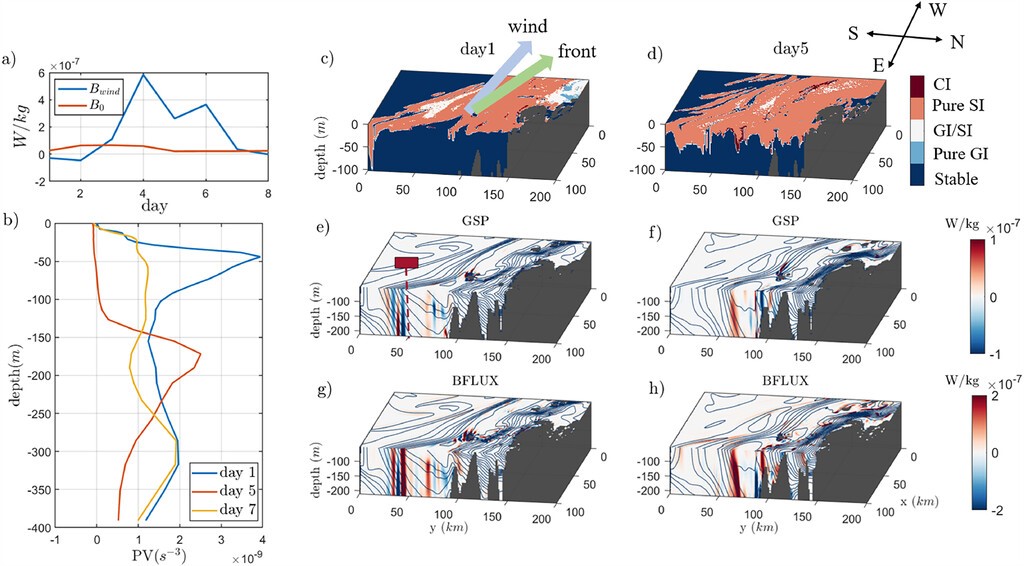
Impact of Downwelling-Favorable Winds on Eddy Formation in the West Greenland Current
West Greenland Current Eddy Formation Physical Oceanography

Impact of Downwelling-Favorable Winds on Eddy Formation in the West Greenland Current

Ruiqi Shu, Ruijian Gou, Clark Pennelly, Yaocheng Deng, Lixin Wu, Ke Xiao, Yitian Huang, Paul G. Myers (2025). Journal of Physical Oceanography.

Using ultrahigh-resolution LAB60 and idealized MITgcm simulations, this study shows that downwelling-favorable winds increase available potential energy and sharpen frontal structure. Frontogenesis dominates over symmetric instability, leading to stronger eddy production and enhanced cross-shelf freshwater transport that can modulate Labrador Sea convection and AMOC variability.

Read Paper
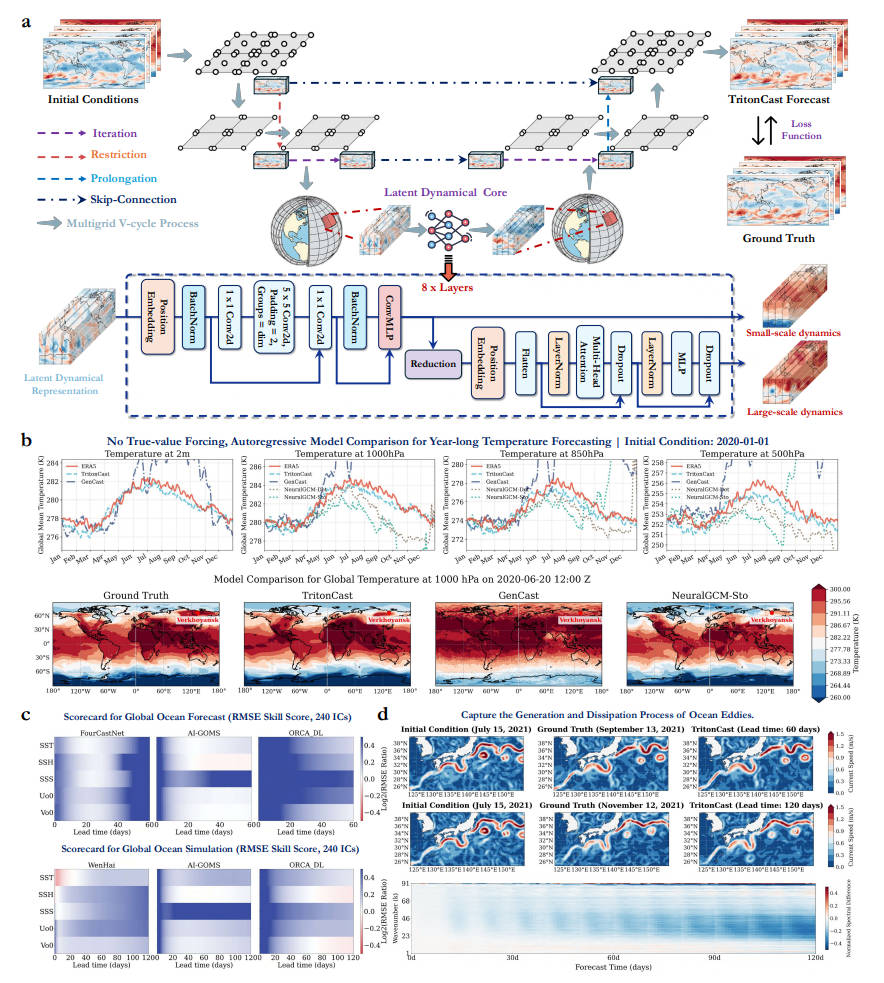
Advanced long-term earth system forecasting by learning the small-scale nature
AI Earth System Long-term Forecasting Small-scale Dynamics

Advanced long-term earth system forecasting by learning the small-scale nature

Hao Wu, Yuan Gao, Ruijian Gou, Kun Wang et al. (2025). arXiv, arXiv:2505.19432.

This work develops TritonCast, a nested framework designed to reduce spectral bias in long-range AI prediction. A latent dynamical core supports large-scale stability, while outer modules resolve fine-scale details and suppress cross-scale error growth. The framework enables multi-year atmospheric climate simulation without drift and improves ocean eddy prediction and cross-resolution generalization.

Read Paper
Cracking the Code of Arctic Sea Ice: Why Models Fail to Predict Its Retreat?
Arctic Sea Ice Model Bias AI Parameterization

Cracking the Code of Arctic Sea Ice: Why Models Fail to Predict Its Retreat?

Ruijian Gou, Gerrit Lohmann, Deliang Chen, Shiming Xu, Ruiqi Shu, Shaoqing Zhang, Lixin Wu (2025). arXiv, arXiv:2511.04961.

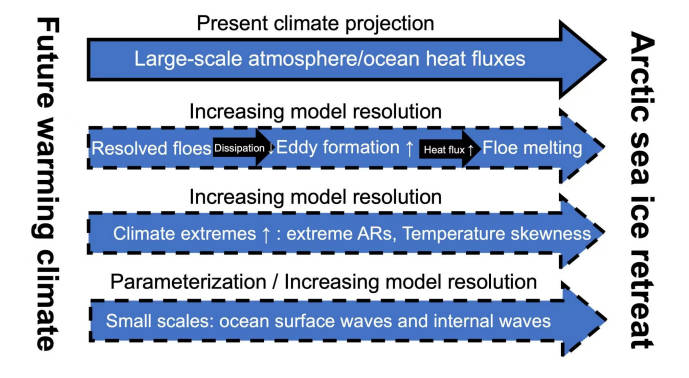
This work argues that low model resolution can lead to systematic underestimation of Arctic sea-ice decline by neglecting small-scale processes such as eddy-floe interaction, polar cyclones, atmospheric rivers and wave-induced melting. It highlights high-resolution configurations and machine-learning parameterization as potential pathways for improving future sea-ice projection.

Read Paper
Arctic Warming Marine Heatwaves EGUsphere

Underestimated future Arctic Ocean warming due to unresolved marine heatwaves

Ruijian Gou, Yaocheng Deng, Yingzhe Cui et al. (2025). EGUsphere, egusphere-2025-5296.

This preprint examines how unresolved marine heatwaves can lead to underestimated future Arctic Ocean warming. It argues that coarse models underresolve marine heatwaves and associated sea-ice melt feedbacks, whereas eddy-resolving simulations produce stronger marine-heatwave–ice-melt positive feedback and stronger Arctic amplification.

Read Paper
Sea-Ice Decline Eddy Dynamics High-resolution Model

Feedback loop between Arctic sea-ice decline and eddy dynamics: Lessons from an ultra-high resolution climate model

Yingjie Liu, Gerrit Lohmann, Ruijian Gou, Guihua Wang, Dmitry V. Sein, Peigen Lin, Deliang Chen, Wenju Cai, Lixin Wu (2025). Research Square.

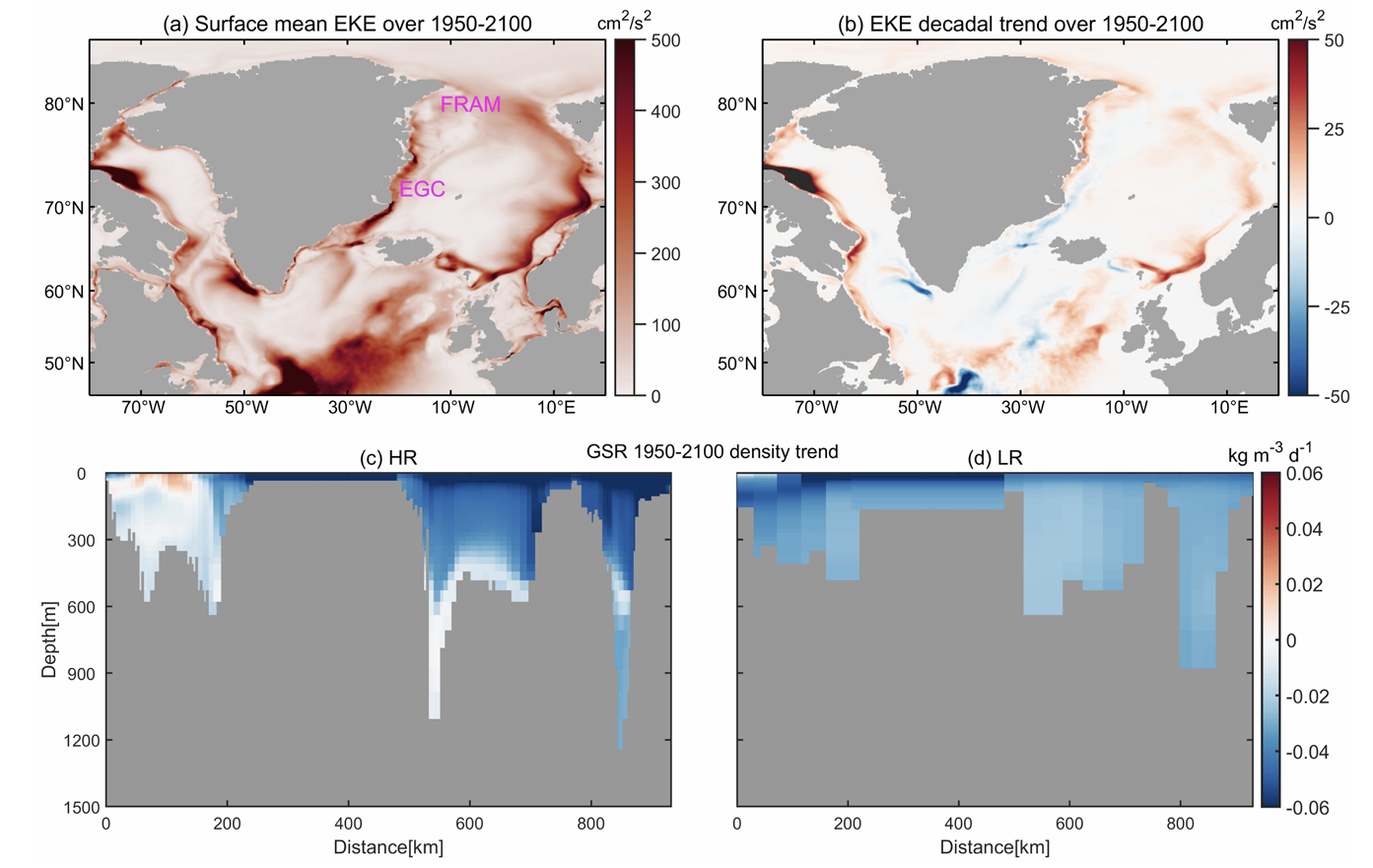
A 2 km eddy-resolving coupled model reveals a self-amplifying feedback in which sea-ice retreat elevates freshwater content and baroclinicity, boosting eddy activity and basal heat supply to accelerate melting. The study suggests that conventional coarse models may underestimate future Arctic ice loss by omitting submesoscale dynamics.

Read Paper
Arctic Warming Extremes Abrupt Shift

An Abrupt Shift in the Arctic Ocean Warming due to Increased Extremes

Yanni Wang, Gerrit Lohmann, Niklas Boers, Ruijian Gou, Deliang Chen, Xiaopei Lin, Xiao Hua Wang, Wenju Cai, Juergen Kurths, Johan Rockström, Jingfang Fan, Stefan Rahmstorf, Chao Li, Lixin Wu (2025). Research Square.

Observation-based analysis identifies an abrupt Arctic warming transition in 2007 associated with the rapid growth of marine heatwaves. The work links enhanced marine-heatwave–ice-albedo feedback to accelerated Arctic amplification and points to increasing tipping risk under continued global warming.

Read Paper

2024

Atlantic Meridional Overturning Circulation Decline: Tipping Small Scales under Global Warming
AMOC Small Scales Physical Review Letters

Atlantic Meridional Overturning Circulation Decline: Tipping Small Scales under Global Warming

Ruijian Gou, Gerrit Lohmann, Lixin Wu (2024). Physical Review Letters, 133, 034201.

Based on a high-resolution coupled climate model, this work diagnoses cross-scale AMOC shifts under global warming. While the basin-scale AMOC weakens persistently, the subpolar North Atlantic shows localized AMOC intensification resolved only in refined grids. The study emphasizes the importance of regional small-scale dynamics for credible AMOC projection.

Read Paper
A plausible emergence of new convection sites in the Arctic Ocean in a warming climate
Arctic Ocean Deep Convection AMOC

A plausible emergence of new convection sites in the Arctic Ocean in a warming climate

Ruijian Gou, Yanni Wang, Ke Xiao, Lixin Wu (2024). Environmental Research Letters.

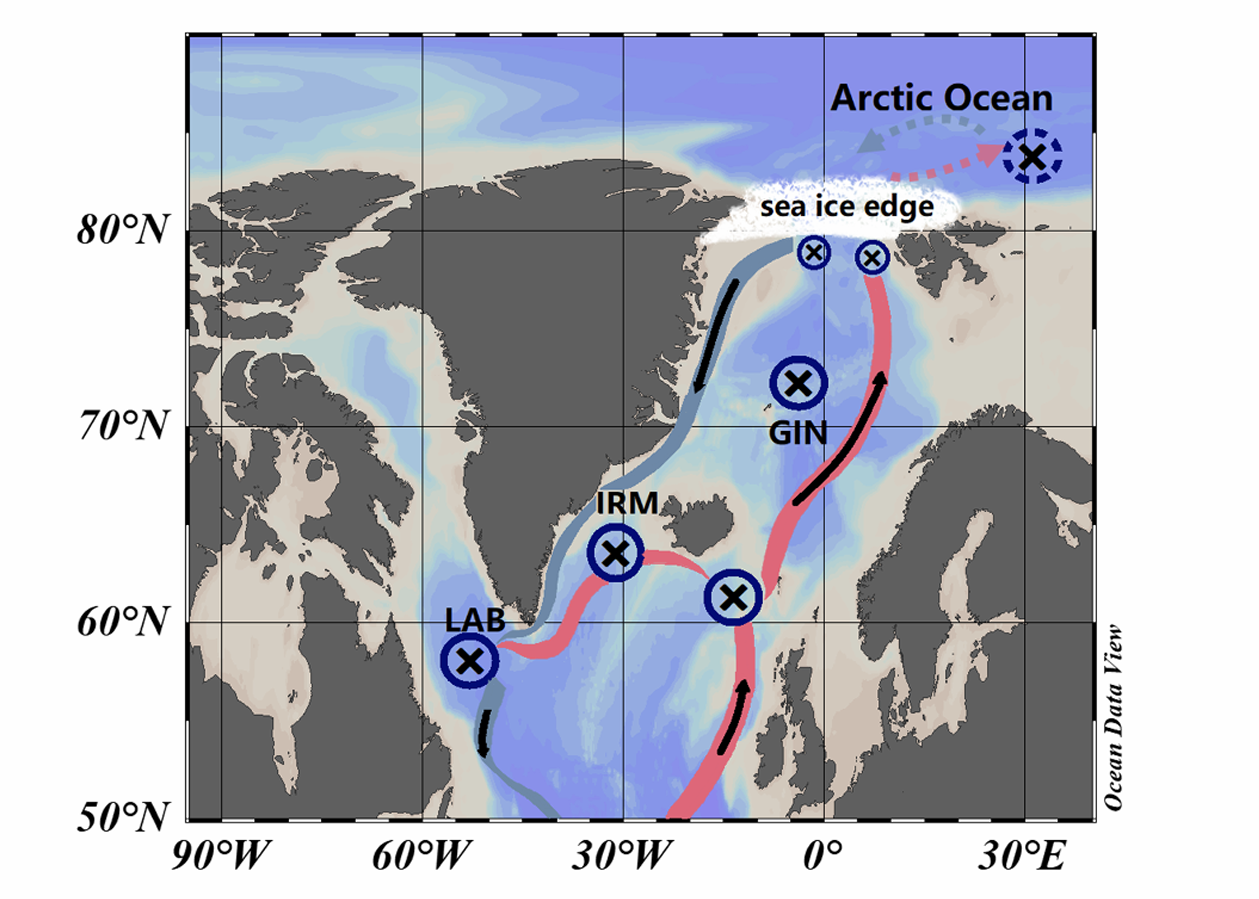
This perspective proposes the potential emergence of new deep convection sites inside the Arctic Ocean under ongoing sea-ice loss. Reduced ice cover strengthens air-sea interaction, cools and salinizes surface water, weakens the halocline and enables vertical exchange with warm Atlantic inflow, forming localized convection and regional AMOC acceleration against a background of basin-wide AMOC decline.

Read Paper

2023

Variability of Eddy Formation off the West Greenland Coast from a 1/60° Model
West Greenland Eddy Formation JPO

Variability of Eddy Formation off the West Greenland Coast from a 1/60° Model

Ruijian Gou, Pusheng Li, Kevin N. Wiegand, Clark Pennelly, Dagmar Kieke, Paul G. Myers (2023). Journal of Physical Oceanography.

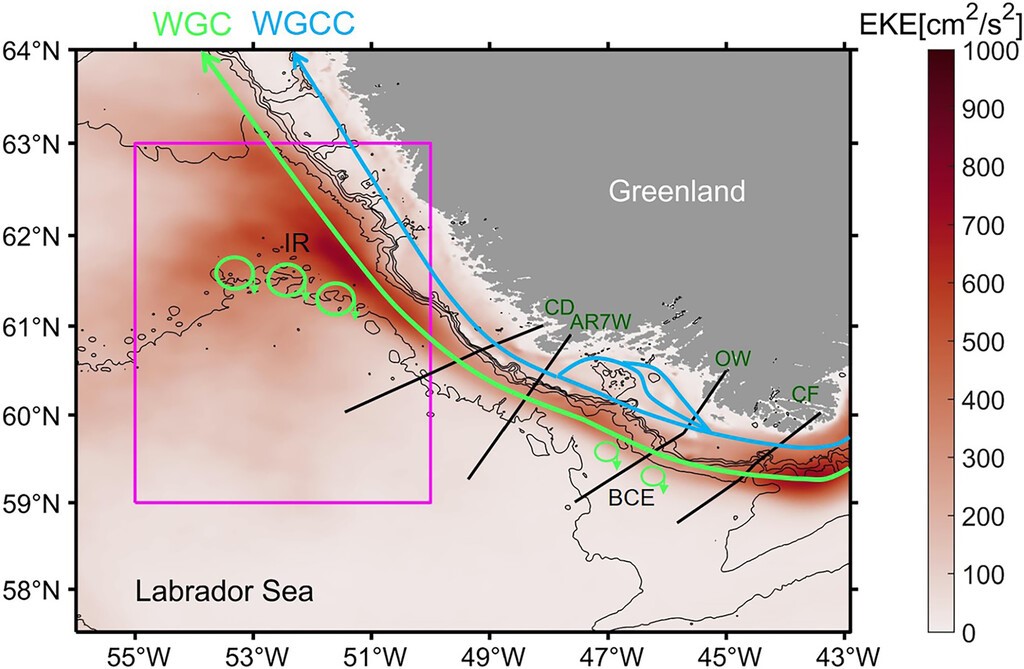
Based on a 1/60° high-resolution simulation, this paper explores the spatiotemporal variability of eddy generation along the West Greenland shelf break. A three-segment pattern of barotropic and baroclinic instability controls Irminger Ring and coastal eddy evolution, while seasonal eddy fluxes and decadal current variability jointly modulate instability changes.

Read Paper
Winter Mixed Layer Restratification Induced by Vertical Eddy Buoyancy Flux in the Labrador Sea
Labrador Sea Vertical Eddy Buoyancy Flux GRL

Winter Mixed Layer Restratification Induced by Vertical Eddy Buoyancy Flux in the Labrador Sea

Pusheng Li, Ruijian Gou, Yiyong Luo, Paul G. Myers (2023). Geophysical Research Letters.

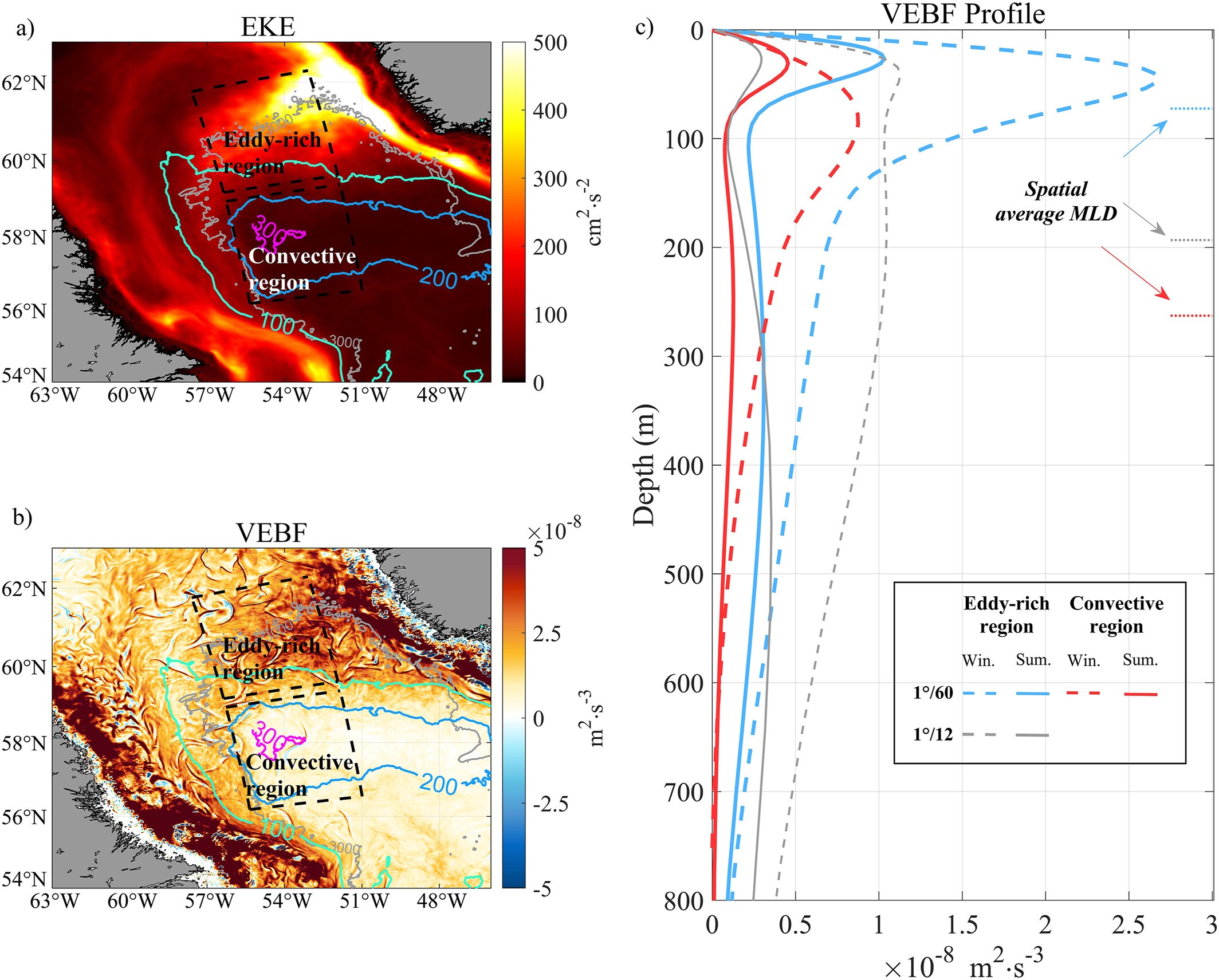
Using a 1/60° high-resolution ocean model, this study quantifies the role of vertical eddy buoyancy flux in controlling Labrador Sea winter stratification and deep convection. VEBF offsets nearly half of surface buoyancy loss and suppresses deep convection development, highlighting the need for improved parameterization of submesoscale vertical processes.

Read Paper

2022

The Changing Behavior of the West Greenland Current System in a Very High-Resolution Model
West Greenland Current Boundary Currents JGR Oceans

The Changing Behavior of the West Greenland Current System in a Very High-Resolution Model

Ruijian Gou, Clark Pennelly, Paul Myers (2022). Journal of Geophysical Research: Oceans, 127, e2022JC018404.

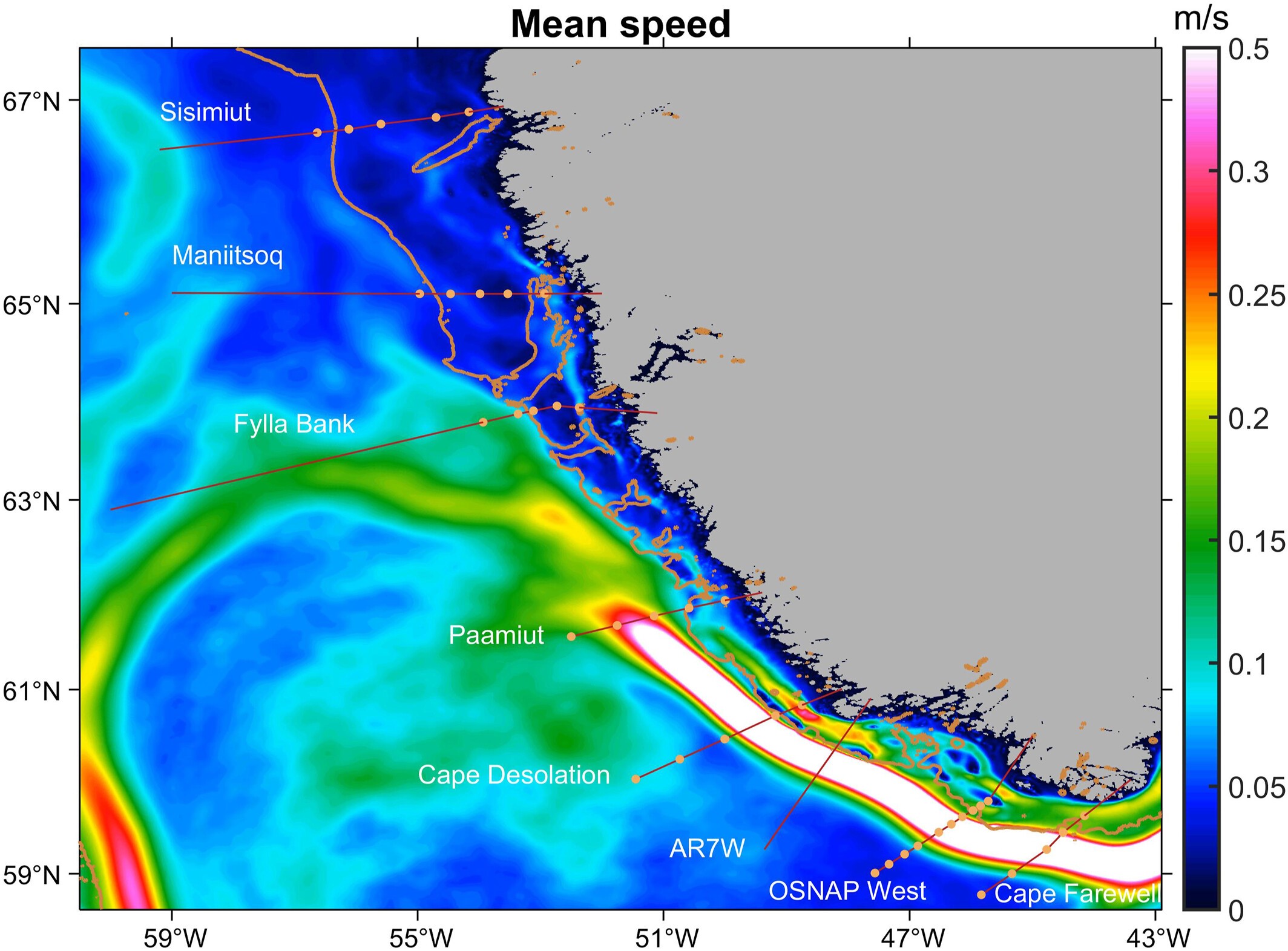
This study uses a 1/60° numerical model to reveal interannual variability of the West Greenland Coastal Current and West Greenland Current over 2008–2018. It shows that most freshwater from Greenland and Arctic melt is transported northward along the boundary current system rather than exchanged into the interior Labrador Sea, challenging traditional views of shelf-basin exchange.

Read Paper

2021

Seasonal Cycle of the Coastal West Greenland Current System Between Cape Farewell and Cape Desolation From a Very High-Resolution Numerical Model
West Greenland Current Seasonal Cycle JGR Oceans

Seasonal Cycle of the Coastal West Greenland Current System Between Cape Farewell and Cape Desolation From a Very High-Resolution Numerical Model

Ruijian Gou, Charlene Feucher, Clark Pennelly, Paul Myers (2021). Journal of Geophysical Research: Oceans, 126, e2020JC017017.

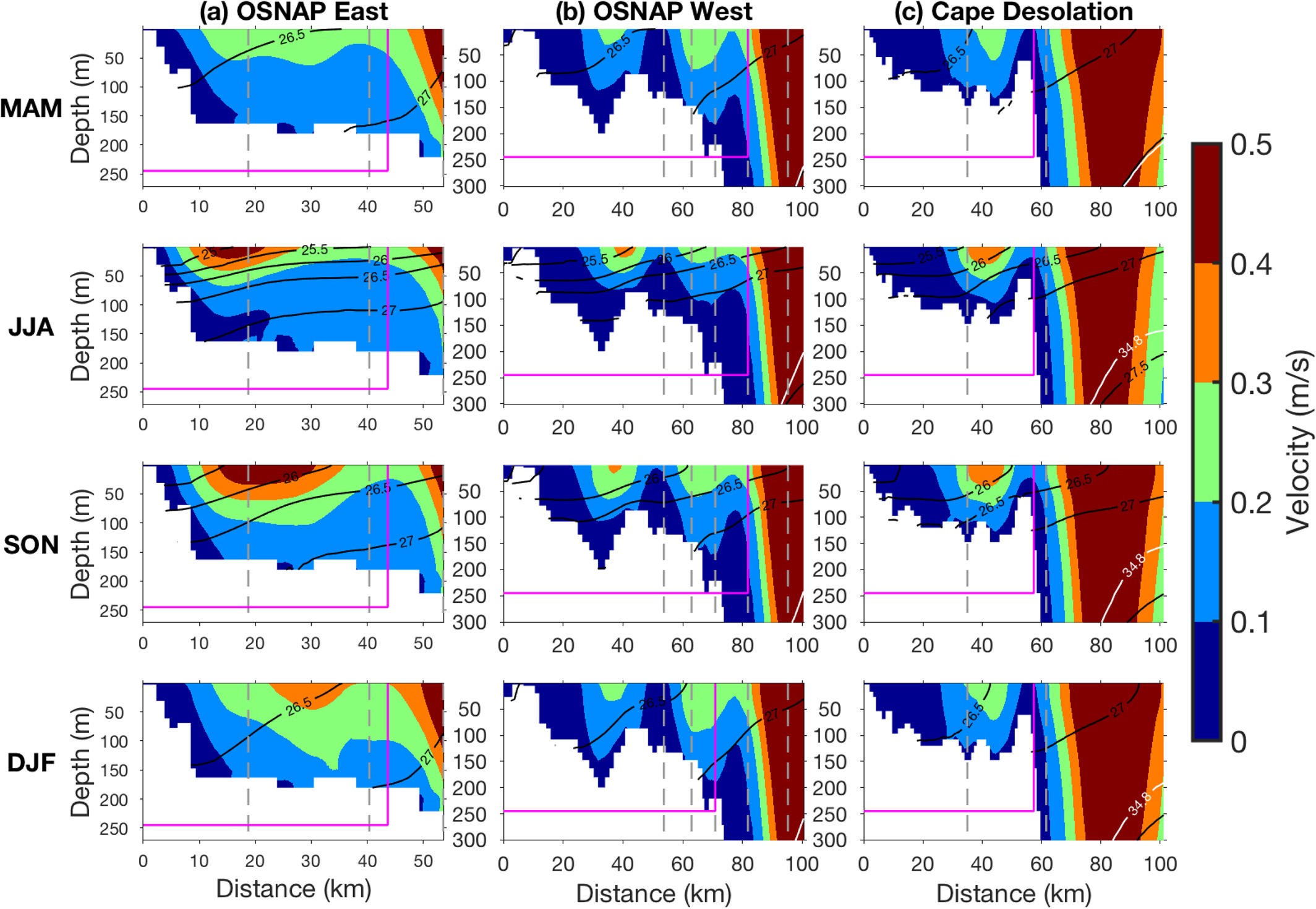
This study uses a 1/60° numerical model to reveal the seasonal cycle of the West Greenland Current system between Cape Farewell and Cape Desolation. It identifies a distinct shelf-break West Greenland Coastal Current that merges with the main WGC jet in winter and separates in summer, providing insight into Greenland meltwater transport toward the Labrador Sea.

Read Paper